Building a Regional Bank's Digital Banking Platform
Overview
First Horizon set out to build their own digital banking platform from the ground up, replacing a dated, out-of-the-box solution that had been capping their feature growth for years. The bank had no internal digital product organization, so they brought in Cabin as the "team before the team": building the product and laying the foundation for what a modern software team looks like inside the bank.
I led design on the Online Account Opening (OAO) workstream, the front door to the entire bank. I also supported other workstreams which included leading a cross-workstream effort to overhaul the platform's information architecture and navigation. Every workstream I touched shipped, and the patterns I helped establish are now being carried forward by First Horizon's growing internal design team.
Categories
0 to 1
Finance
Date
Jun 2025 - Feb 2026
Client
Regional Bank
Opportunity
First Horizon is a regional U.S. bank that has been running its digital experience on a third-party out-of-the-box platform. It worked, but it limits what they could build, how fast they could move, and how the experience could differentiate them.
The decision was made to build their own platform (web+native). But there was a complication: the bank didn't have an internal digital product team to build it. That's where Cabin came in. The mandate was twofold. First, ship a modern banking platform. Second, lay the cultural and operational groundwork for First Horizon to eventually take it over and run it themselves.
I joined about four months into the engagement after the high level planning and roadmapping had been laid. The program was structured into five workstreams, each led by Cabin designers, strategists, and PMs working in tight collaboration. I was placed on Online Account Opening, the workstream responsible for getting new customers through the door.
Designing for two audiences
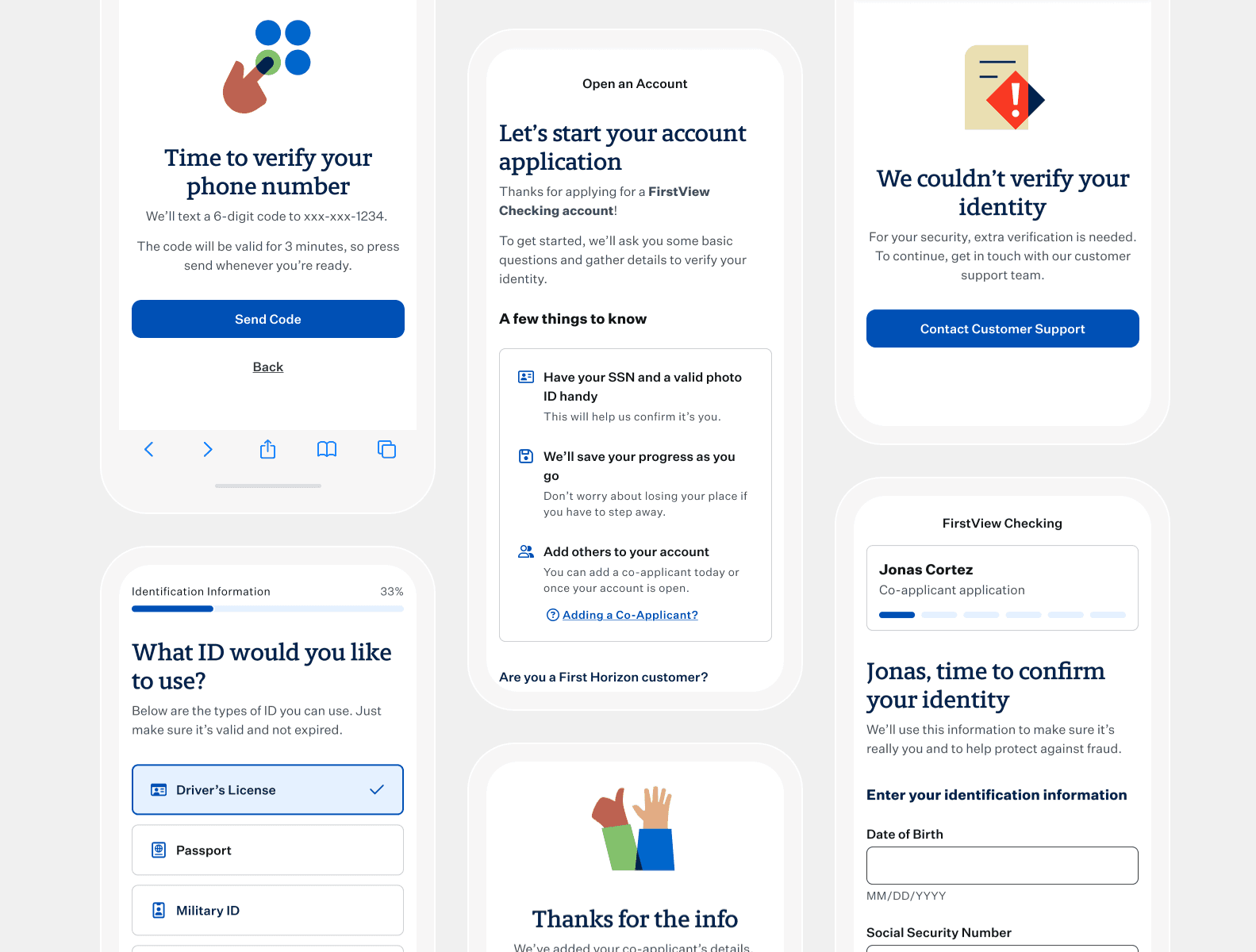
The OAO experience had to serve two different customer journeys:
Existing First Horizon customers opening an additional account. This was the faster path, since we could pull most of their information from records.
New-to-bank customers. This was a longer flow, since we had to gather, verify, and authenticate everything from scratch.
The whole experience was designed to be fully responsive across mobile and desktop, with patterns optimized for each context. The guiding principle I held throughout was this: be as clear and compliant as possible while expediting the experience wherever the technology allowed. Identity authentication tools were integrated to speed up the parts of the flow that traditionally bog applicants down. Compliance and legal copy were treated as first-class design problems, not afterthoughts.
Because OAO was further along than most other workstreams, our team became something of an early adopter. We established patterns for legal review, QA processes, and responsive behavior that other workstreams later adopted as their own work matured.
The hardest tradeoff: the co-applicant problem
The clearest constraint we ran into was around adding a co-applicant to an account.
Originally, we'd scoped a separate, dedicated co-applicant experience. The co-applicant would receive their own invitation and complete their portion of the application in a flow purpose-built for them. It was the right design solution and it would have produced a cleaner experience for both applicants.
But as we got closer to launch, the technical runway didn't allow for a fully separate flow. We had to make a call: push the timeline for launch, or find a stop-gap that worked within the constraints we had.
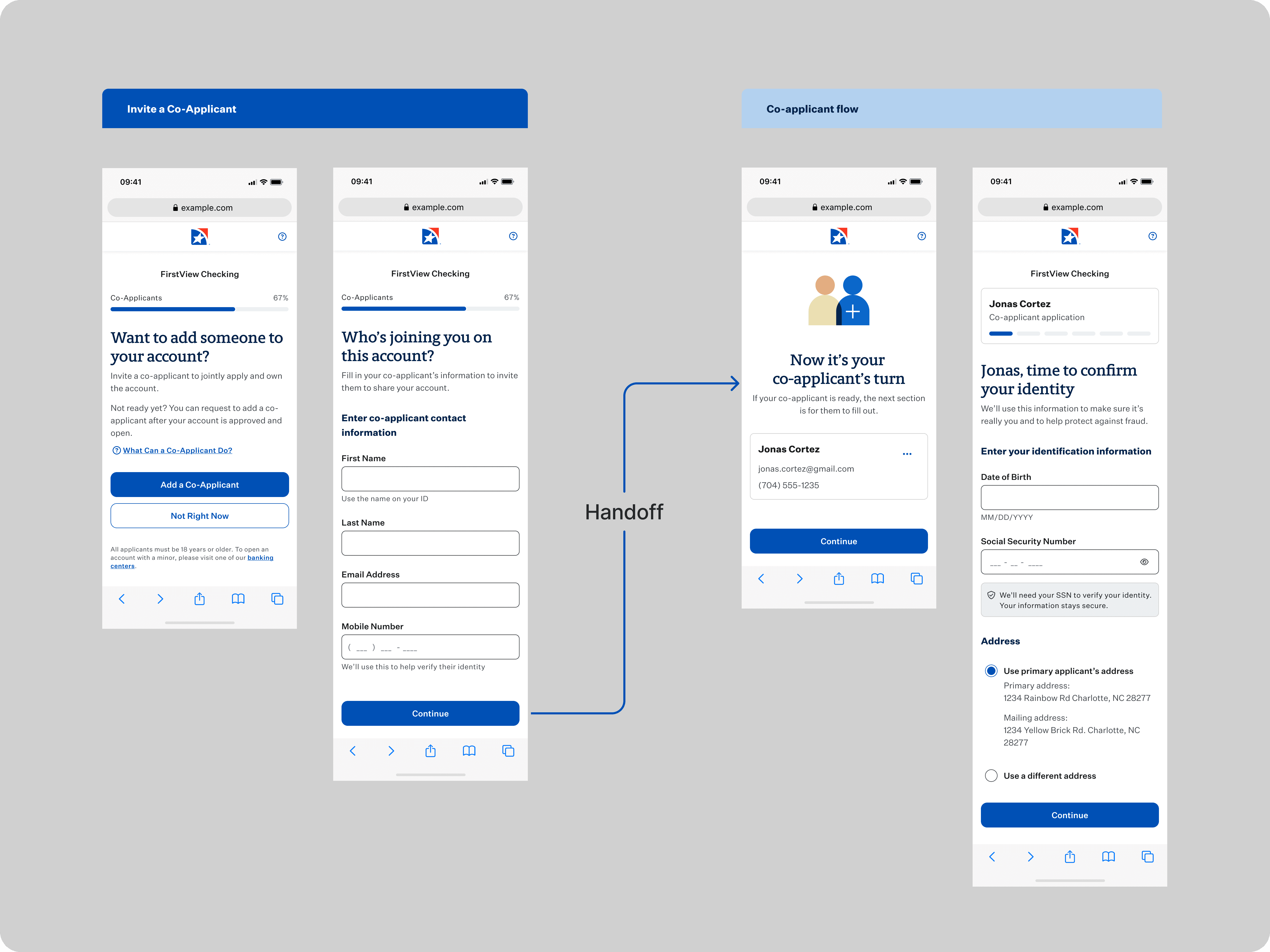
I designed an embedded co-applicant flow. The secondary applicant's information was gathered inside the primary applicant's session, with clear handoffs and explicit moments where the primary applicant indicated they were entering co-applicant data on their behalf. It wasn't the experience I'd originally designed, but it was the right call for the launch window. The dedicated flow remained on the roadmap for a future phase.
This is the kind of tradeoff that comes up constantly in 0→1 work, and it taught me something I keep coming back to: the best design decision in isolation isn't always the best solution in context. Honoring the launch and the team's capacity was as much part of the design problem as the UX itself.
Beyond the workstream: leading a navigation overhaul
One of the things I value about working in a multi-workstream environment is the ability to step outside your lane when the work calls for it. On this engagement, that moment came around navigation.
As the program matured, it became clear that the platform's web navigation wasn't holding up. The original navigation had been derived from earlier work on the native app, a reasonable starting point, but as more workstreams shipped features into the web experience, the structure couldn't carry the load. Users were going to get lost.
I partnered with the workstream that owned web navigation to lead an overhaul. The approach:
Map the full information architecture. We mapped both current state and future state, across every workstream's planned features. This gave us a shared picture of what the navigation actually had to support.
Surface the connections. Once the IA was on the wall, the relationships between features and the right groupings became visible.
Generate options. We produced multiple navigation models, each with different tradeoffs.
Test with users. I partnered with our UX researcher to put the options in front of real users and run multiple rounds of iteration.
Land the solution and apply it consistently. We rolled the winning navigation pattern out to both desktop and mobile web, and established in-page navigation patterns that other workstreams could adopt.
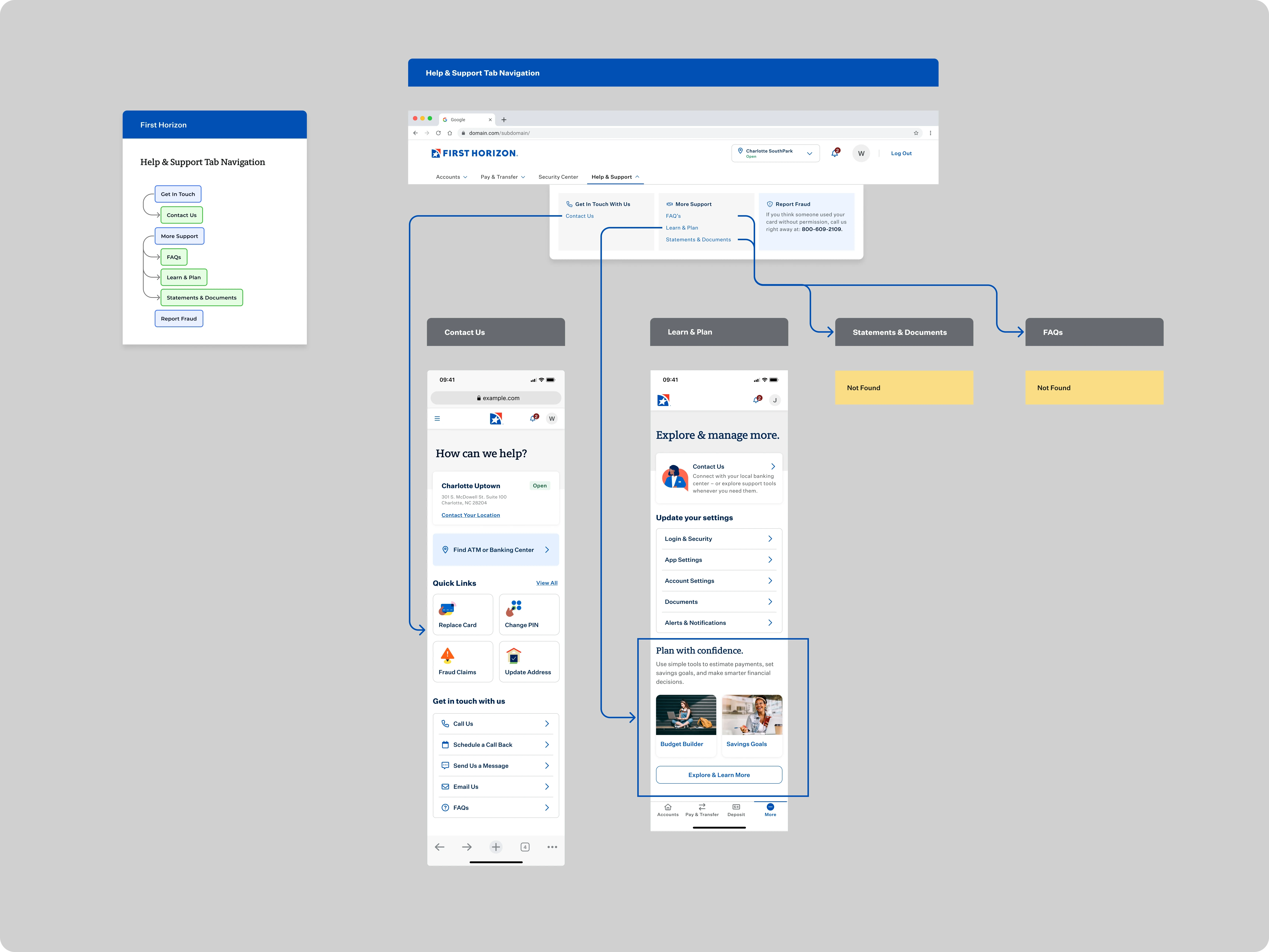
This work cut across every team. It required pulling people in, getting alignment on a shared IA, and trusting the research to settle disagreements that were going to come up no matter what. It's the kind of work that's invisible when it goes well, a navigation people don't have to think about, and it's some of the most important work a senior designer can do on a 0→1 product.
Result
OAO shipped launch-ready. The navigation overhaul shipped across desktop and mobile and became the platform's foundational navigation model. Patterns I established, including legal review processes, QA cadence, and responsive behavior, were adopted by other work-streams. All of my work was handed off to and carried forward by the bank's growing internal design team.
Outcomes
OAO completed its workstream and is ready for launch. The broader platform release is staged, but the work is done and shipping-ready.
The web navigation overhaul shipped across desktop and mobile and is the navigation model the platform launches on.
All my work lived on after I rolled off. Cabin was structured as the "team before the team," and as our work wound down, First Horizon's internal design team was building up to take it over. The handoff was the point.
Patterns I helped establish on OAO (legal review processes, QA cadence, responsive behavior) were adopted by other workstreams as they matured.


Reflection
In a mature product, the existing system is the alignment. New work has to fit the patterns already in place, the IA already established, the design language already set. There's friction, but there's also gravity. Things naturally pull toward consistency.
In 0→1 work, none of that exists yet. Every workstream is creating net-new patterns and experiences in parallel, and without deliberate, ongoing coordination, the product fragments into five products that happen to share a logo. Alignment isn't a nice-to-have. It's the thing that makes the difference between a unified experience and a Frankenstein.
Greenfield projects are uniquely positioned to take advantage of AI-assisted ideation. Without an established product to work around, early exploration can move faster and the cost of a wrong turn is lower. On this engagement we didn't have that option since AI use hadn't been cleared by the client, but it changed how I think about scoping greenfield work going forward.
Building a Regional Bank's Digital Banking Platform
Overview
First Horizon set out to build their own digital banking platform from the ground up, replacing a dated, out-of-the-box solution that had been capping their feature growth for years. The bank had no internal digital product organization, so they brought in Cabin as the "team before the team": building the product and laying the foundation for what a modern software team looks like inside the bank.
I led design on the Online Account Opening (OAO) workstream, the front door to the entire bank. I also supported other workstreams which included leading a cross-workstream effort to overhaul the platform's information architecture and navigation. Every workstream I touched shipped, and the patterns I helped establish are now being carried forward by First Horizon's growing internal design team.
Categories
0 to 1
Finance
Date
Jun 2025 - Feb 2026
Client
Regional Bank
Opportunity
First Horizon is a regional U.S. bank that has been running its digital experience on a third-party out-of-the-box platform. It worked, but it limits what they could build, how fast they could move, and how the experience could differentiate them.
The decision was made to build their own platform (web+native). But there was a complication: the bank didn't have an internal digital product team to build it. That's where Cabin came in. The mandate was twofold. First, ship a modern banking platform. Second, lay the cultural and operational groundwork for First Horizon to eventually take it over and run it themselves.
I joined about four months into the engagement after the high level planning and roadmapping had been laid. The program was structured into five workstreams, each led by Cabin designers, strategists, and PMs working in tight collaboration. I was placed on Online Account Opening, the workstream responsible for getting new customers through the door.
Designing for two audiences
The OAO experience had to serve two different customer journeys:
Existing First Horizon customers opening an additional account. This was the faster path, since we could pull most of their information from records.
New-to-bank customers. This was a longer flow, since we had to gather, verify, and authenticate everything from scratch.
The whole experience was designed to be fully responsive across mobile and desktop, with patterns optimized for each context. The guiding principle I held throughout was this: be as clear and compliant as possible while expediting the experience wherever the technology allowed. Identity authentication tools were integrated to speed up the parts of the flow that traditionally bog applicants down. Compliance and legal copy were treated as first-class design problems, not afterthoughts.
Because OAO was further along than most other workstreams, our team became something of an early adopter. We established patterns for legal review, QA processes, and responsive behavior that other workstreams later adopted as their own work matured.
The hardest tradeoff: the co-applicant problem
The clearest constraint we ran into was around adding a co-applicant to an account.
Originally, we'd scoped a separate, dedicated co-applicant experience. The co-applicant would receive their own invitation and complete their portion of the application in a flow purpose-built for them. It was the right design solution and it would have produced a cleaner experience for both applicants.
But as we got closer to launch, the technical runway didn't allow for a fully separate flow. We had to make a call: push the timeline for launch, or find a stop-gap that worked within the constraints we had.
I designed an embedded co-applicant flow. The secondary applicant's information was gathered inside the primary applicant's session, with clear handoffs and explicit moments where the primary applicant indicated they were entering co-applicant data on their behalf. It wasn't the experience I'd originally designed, but it was the right call for the launch window. The dedicated flow remained on the roadmap for a future phase.
This is the kind of tradeoff that comes up constantly in 0→1 work, and it taught me something I keep coming back to: the best design decision in isolation isn't always the best solution in context. Honoring the launch and the team's capacity was as much part of the design problem as the UX itself.
Beyond the workstream: leading a navigation overhaul
One of the things I value about working in a multi-workstream environment is the ability to step outside your lane when the work calls for it. On this engagement, that moment came around navigation.
As the program matured, it became clear that the platform's web navigation wasn't holding up. The original navigation had been derived from earlier work on the native app, a reasonable starting point, but as more workstreams shipped features into the web experience, the structure couldn't carry the load. Users were going to get lost.
I partnered with the workstream that owned web navigation to lead an overhaul. The approach:
Map the full information architecture. We mapped both current state and future state, across every workstream's planned features. This gave us a shared picture of what the navigation actually had to support.
Surface the connections. Once the IA was on the wall, the relationships between features and the right groupings became visible.
Generate options. We produced multiple navigation models, each with different tradeoffs.
Test with users. I partnered with our UX researcher to put the options in front of real users and run multiple rounds of iteration.
Land the solution and apply it consistently. We rolled the winning navigation pattern out to both desktop and mobile web, and established in-page navigation patterns that other workstreams could adopt.
This work cut across every team. It required pulling people in, getting alignment on a shared IA, and trusting the research to settle disagreements that were going to come up no matter what. It's the kind of work that's invisible when it goes well, a navigation people don't have to think about, and it's some of the most important work a senior designer can do on a 0→1 product.
Result
OAO shipped launch-ready. The navigation overhaul shipped across desktop and mobile and became the platform's foundational navigation model. Patterns I established, including legal review processes, QA cadence, and responsive behavior, were adopted by other work-streams. All of my work was handed off to and carried forward by the bank's growing internal design team.
Outcomes
OAO completed its workstream and is ready for launch. The broader platform release is staged, but the work is done and shipping-ready.
The web navigation overhaul shipped across desktop and mobile and is the navigation model the platform launches on.
All my work lived on after I rolled off. Cabin was structured as the "team before the team," and as our work wound down, First Horizon's internal design team was building up to take it over. The handoff was the point.
Patterns I helped establish on OAO (legal review processes, QA cadence, responsive behavior) were adopted by other workstreams as they matured.
Reflection
In a mature product, the existing system is the alignment. New work has to fit the patterns already in place, the IA already established, the design language already set. There's friction, but there's also gravity. Things naturally pull toward consistency.
In 0→1 work, none of that exists yet. Every workstream is creating net-new patterns and experiences in parallel, and without deliberate, ongoing coordination, the product fragments into five products that happen to share a logo. Alignment isn't a nice-to-have. It's the thing that makes the difference between a unified experience and a Frankenstein.
Greenfield projects are uniquely positioned to take advantage of AI-assisted ideation. Without an established product to work around, early exploration can move faster and the cost of a wrong turn is lower. On this engagement we didn't have that option since AI use hadn't been cleared by the client, but it changed how I think about scoping greenfield work going forward.